Oil Price Impact on India: 5 Shocking Economic Risks
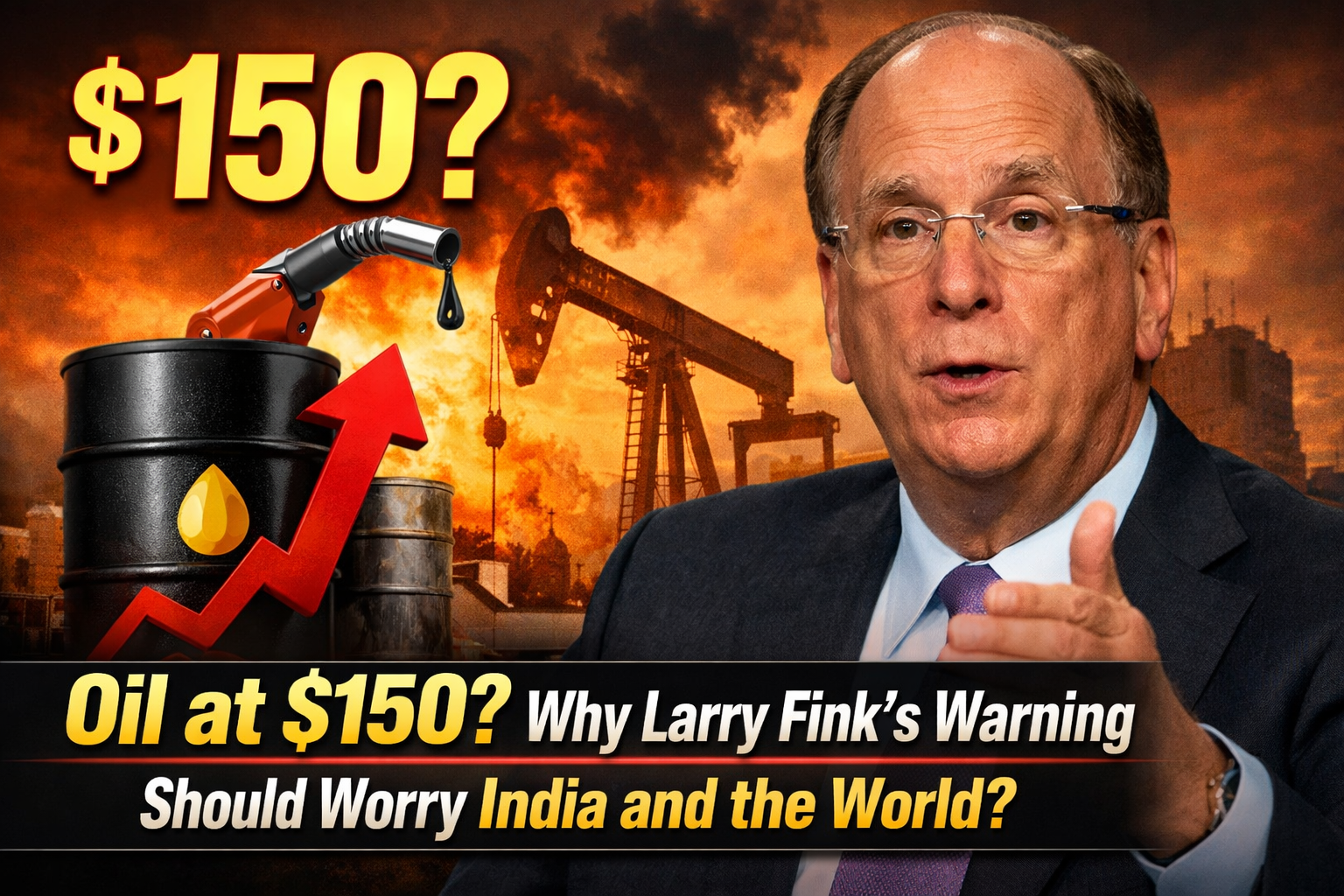
If prices surge to $150 per barrel, it won’t just be another market headline, it could be the trigger for the next global economic crisis.
That’s the stark warning from Larry Fink, CEO of BlackRock, who believes prolonged geopolitical tensions especially involving Iran, could send shockwaves through the global economy.
For India, one of the world’s largest importers, this isn’t just theory. It’s a potential economic storm.
Why $150 Oil Is a Breaking Point and Price Impact on India’s Economy The prospect of reaching $150 per barrel raises significant concerns for India and the global economy.
It isn’t just another commodity, it powers transport, industry, agriculture, and supply chains. When prices spike, everything becomes more expensive. Fink outlines two possible futures:
- Best case: Middle East tensions ease, oil prices cool
- Worst case: Prolonged conflict pushes oil above $100–$150 for years
The second scenario, he warns, could lead to a “steep and severe recession.” This isn’t fearmongering. Historically, sharp price spikes have often preceded economic slowdowns. Price impact on India is becoming a major concern as rising crude prices affect inflation and economic growth.
Why India Should Be Especially Concerned
For a country like India, rising oil prices aren’t just another global headline, they have a direct and immediate impact on everyday life and the overall economy. Here’s why it matters more for India than for many other nations:
1. Pressure on the Rupee
India depends heavily on imported crude oil, with more than 80% of its demand coming from overseas. When oil prices rise, the country has to spend more dollars to buy the same amount of oil.
This increases demand for the US dollar and puts pressure on the Indian rupee, often leading to its depreciation. A weaker rupee then makes imports even more expensive creating a cycle that’s hard to control.
2. Rising Inflation Across the Board
Higher fuel prices don’t just affect what you pay at the petrol pump, they quietly push up costs across the entire economy.
- Transportation becomes more expensive, increasing food prices
- Manufacturing costs rise, making goods costlier
- Daily essentials from vegetables to household items see price hikes
In simple terms, when fuel gets expensive, almost everything else follows. This hits middle- and lower-income households the hardest, as a larger portion of their income goes toward basic needs. Price impact on India is becoming a major concern as rising crude prices affect inflation and economic growth.
3. Slower Economic Growth
When costs go up, people tend to spend less. At the same time, businesses face shrinking profit margins due to higher input costs.
This combination lower consumer spending and reduced corporate earnings can slow down overall economic growth. Since consumption and business activity are key drivers of India’s GDP, expensive oil can act as a drag on the country’s progress.
The Energy Reality Check
Fink makes one thing clear: energy policy can’t be ideological, it has to be practical. “Use what you have, but invest aggressively in alternatives.” For India, this reinforces the urgency of:
- Expanding solar capacity
- Investing in green hydrogen
- Reducing dependence on imports
Ironically, a crisis could accelerate India’s clean energy transition.
No 2008 Repeat, But That Doesn’t Mean Safety
Despite rising risks, Fink dismisses comparisons to the 2007–2008 financial crisis. Banks are stronger. Regulations are tighter. But here’s the catch: This crisis, if it comes, won’t start in banks, it will start with energy that makes it harder to predict and potentially broader in impact.
AI Boom vs Energy Crisis: A Hidden Clash
While markets are busy debating whether AI is overhyped, Fink says the bigger issue is being ignored: energy supply. Countries like China are aggressively investing in:
- Solar
- Nuclear
- Power infrastructure
Meanwhile, others risk falling behind. AI needs massive data centers. Data centres need cheap electricity.
No power = no AI dominance.

What Experts Are Saying Short-Term Effects of Oil Prices ?
Across global markets, there’s a growing sense of agreement among economists, analysts, and tech leaders: the risks tied to rising oil prices and energy shortages are real and they’re interconnected.
Oil = A Trigger for Persistent Inflation
Many economists believe that if crude oil prices stay elevated for a prolonged period, inflation could remain stubbornly high across major economies.
This creates a ripple effect:
- Central banks may delay cutting interest rates
- Borrowing costs could stay higher for longer
- Emerging markets may face the biggest pressure due to weaker currencies and higher import bills
In short, expensive fuel doesn’t just raise costs, it makes it harder for economies to cool inflation and support growth at the same time.
Price impact on India is becoming a major concern as rising crude prices affect inflation and economic growth.
India’s Key Weak Spot
Market analysts often point out that while India has one of the fastest-growing major economies, its dependence on imported energy remains a critical vulnerability.
The concern is simple:
India’s growth story is strong, but it is still heavily tied to global oil prices. Any sharp or sustained rise in crude can quickly impact inflation, currency stability, and overall economic momentum.
AI Is Real But the Gains May Not Be Equal
On the technology front, experts largely agree with Larry Fink’s broader point: artificial intelligence is not hype—it will reshape industries and economies.
However, the benefits may not be evenly distributed. Early gains are likely to be concentrated among:
- Large corporations with access to massive data and computing power
- Wealthier nations that can invest heavily in infrastructure and energy
Without timely policy interventions, this imbalance could widen the gap between countries and even within societies creating a new layer of economic inequality in the AI era.
What Will Be the Impact?
If oil touches $150 and stays there, expect real, visible consequences:
1. Global Recession Risk
Major economies including the US and Europe could slow sharply.
2. Cost of Living Crisis
Fuel, food, electricity everything becomes more expensive.
3. Faster Shift to Renewables
High oil prices could push countries toward solar and wind at record speed.
4. Stock Market Volatility
Energy, aviation, and manufacturing stocks could see major swings.
5. Job Market Shift
AI and infrastructure growth may boost demand for:
- Electricians
- Technicians
- Skilled labor
The Bottom Line (Opinion)
Here’s the uncomfortable truth: The global economy is still dangerously dependent on and geopolitics. Fink’s warning isn’t just about energy prices. It’s about how fragile the system remains. For India, this is a wake-up call. Price impact on India is becoming a major concern as rising crude prices affect inflation and economic growth.
- Reduce oil dependence
- Accelerate clean energy
- Build resilience now not later
Because if it really hits $150, the question won’t be whether it hurts the economy.